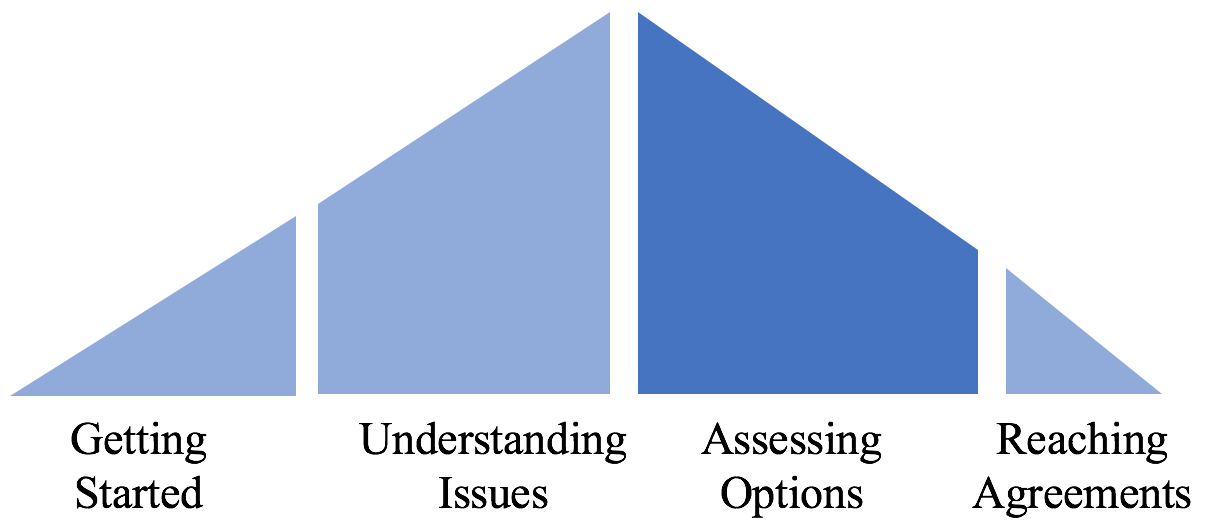
After a collaborative group has explored issues that need to be addressed, and has brainstormed ways to deal with the issues, they need to start to identify packages of options that deal with the issues. To reach agreement, stakeholders need to begin narrowing and combining options into a specific package that adequately satisfies the interests of each participant or stakeholder group. In the MLPA process, subgroups began to assemble sets of protected areas that collectively became a reserve network. In doing so, they included some elements that were supported by some stakeholders and other elements supported by other stakeholders. This process of give-and-take helped to build agreement.
A facilitator can use a variety of strategies to help a group navigate their differences to identify a single package or proposal. These include mechanisms for:
- Shifting from Inventing to Narrowing: Ways to help participants make the shift from brainstorming to narrowing and discerning.
- Narrowing Proposals and Packaging: Techniques to help participants to narrow and combine a range of options into specific proposals for viable solutions.
- Visualization: Methods of showing proposed options to ensure participants share a common understanding of options being discussed.
- Assessing Preferences: Approaches such as straw polls, voting, and ranking that provide ways to gauge a group’s preferred solution or solutions, and to use that preference to make a decision.